MIT-developed ‘Bokodes’ could replace bar codes
28 July, 2009
category: RFID
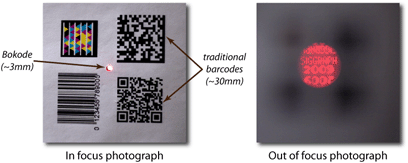
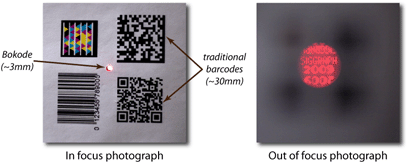 MIT’s Media Lab has announced the creation of the Bokode, a new optical data storage tag with the capacity to store a million times more data than a bar code in only 3mm of space.
The Bokode is comprised of a lens and an LED light source. Information is encoded in the angle and brightness of the beam of light, rather than in a flat image like a bar code. Bokodes can be read from a distance of a few meters by any off-the-shelf digital camera and do not require a specific reading device like bar codes or RFID tags.
The Bokode gets its name from the Japanese photography term “bokeh,” or the aesthetic rendition of out-of-focus points of light, which appear as flat disks in a photograph. This name refers to the way in which a Bokode can be read by manipulating a digital camera’s focus so that the light emitted by the Bokode appears in the frame as a flat “bokeh” disk. The information encoded in the beam then becomes legible on the surface of the disk (as seen in photograph).
Bokode prototypes are far more expensive than RFID tags at $5 a label but Media Lab associate professor Ramesh Raskar believes the price could be reduced to $0.05 a tag if produced in volume, according to the MIT News Service.
Passive versions of the tag, which rely on reflected light, are also being developed.
The MIT Media Lab researchers predict many diverse applications for the Bokode, from skimming health information off of items at the supermarket to improving the quality of motion capture technology in films and video games.
Read more