Radio Frequency Identification Technology for Logistics, Tagging and EPC

USDA: Judge should pull plug on Amish case

Friday, November 14, 2008

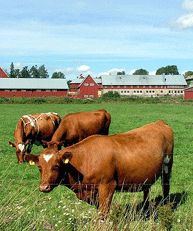
The United States Department of Agriculture urged a federal judge on Thursday to dismiss a case brought by a group of Amish farmers in Michigan. The farmers feel that a program, which used RFID tags to track and prevent disease in cattle, is an infringement on their fundamental religious beliefs and constitutes the “mark of the beast.”


The farmers contend that a Michigan law requiring the tagging is a result of a mandate created by a federally-funded grant program, and that this justifies the suit against the USDA. According to the lawsuit, filed in September in the U.S. District Court for the District of Columbia, the Michigan law “constitutes some form of a ‘mark of the beast’ and/or represents an infringement of their ‘dominion over cattle and all living things’ in violation of their fundamental religious beliefs.”

The USDA responds that their tagging program is voluntary, and that it would be more appropriate for the farmers to direct their grievances at the state. According to the USDA’s response, the farmers “cannot establish that any rule issued or action taken by the USDA either mandates the use of RFID tags on livestock located within Michigan, or, conversely, prevents the Michigan Department of Agriculture from granting appropriate religious exemptions imposed by that department.”

The Farm-to-Consumer Legal Defense Fund, based in Virginia, filed the case on behalf of the farmers.

As RFID technology becomes more integrated into daily life, accusations of its role as the biblical “mark of the beast” have become more frequent. The USDA’s response, however, does not directly address any Satan-related issues in the programs, either voluntary or required.

Read more here[end] 

Gemalto launched the Ezio 
Plug & Sign, a corporate banking device that tackles automated clearinghouse and 
wire transfer fraud.

The Ezio Plug & Sign is a zero footprint device that provides a secure Web browser 
for online banking, also called a “safe zone,” to overcome the risks of an open online environment. In addition it provides the ability to extend the services that can be offered to the users, 
including secure email, secure electronic bank account management and secure statement viewing.

read more »

The Huntsville, Ala. school district is conducting a pilot program that will track when and where students get on and off the bus. Currently, three schools–an elementary, middle and high school–are involved in the pilot.

read more »

Will Judge, head of future ticketing at Transport for London, has promised that confidential information stored on a user’s contactless bank card will be “100 percent safe” from fraud, according to ZDNet UK.

read more »

The U.S. government has settled an infringement case with Leighton Technologies by agreeing to license its smart cards.

Leighton Technologies, a subsidiary of General Patent, filed a case against the federal government in the U.S. Court of Federal Claims in January 2010. Leighton alleged that 54 federal agencies used its six smart card patents without authorization. Leighton’s technology was also used in e-passports.

read more »

Pethealth Inc. announced the roll out of an ISO-standard MiniChip for use with companion animal RFID applications.

Approximately one-third the size of a standard microchip – which itself is roughly the size of a grain of rice - the MiniChip is designed to offer a smaller-scale alternative without compromising any of the protective benefits.

read more »

Consumerist reports that Senator Bob Casey of Pennsylvania has written to Apple in hopes of getting the company to pull the “Driver’s License” app from its store.

read more »